
Italian coalition in disarray after Berlusconi's ministers quit
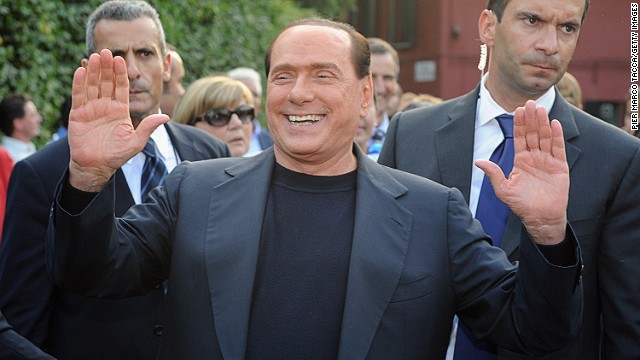
Italy's former Prime Minister Silvio Berlusconi on July 1 in Milan, Italy.
Mr Berlusconi, leader of
the centre-right Forza Italia party, said the resignations were a
response to the government's decision on Friday to increase in sales tax
from next month.
Mr Letta, prime minister,
rejected Mr Berlusconi's explanation as an "enormous lie", and called
the decision "mad and irresponsible and aimed exclusively at covering up
his personal affairs" -- a reference to Mr Berlusconi's criminal
conviction for tax fraud which is likely to lead to a ban on holding
public office.
The unprecedented
coalition of the two parties -- forced upon both sides by elections last
February that ended in deadlock -- has been hanging by a thread since
Mr Berlusconi lost his final appeal against tax fraud on August 1.
The crisis gathered pace
on Wednesday night. Just as Mr Letta was in New York telling investors
on Wall Street that Italy was "young, virtuous and credible", Mr
Berlusconi's parliamentarians threatened to stage a mass resignation if a
senate committee voted on October 4 to strip their leader of his seat
in the upper house.
The way ahead is fraught
with difficulties for Mr Letta and his ally Giorgio Napolitano, head of
state, with little time to prevent a serious fallout on financial
markets on Monday. Rumours were already spreading last week that Italy
was heading for another downgrade by a major rating agency.
In downgrading Italy to
just two levels above junk status in July, Standard & Poor's warned
of a further downgrade "by one notch or more" if Italy could not
demonstrate "institutional and governance effectiveness". As Mr Letta
has repeatedly warned, Italy can ill-afford higher costs in servicing
its €2tn of public debt, with its budget deficit for 2013 currently
forecast to overshoot the 3 per cent limit agreed with the EU.
Mr Letta confirmed in his
statement that he would go before parliament "where everyone will
assume their own responsibility in front of the country". Commentators
expected Mr Letta to address parliament on Monday, but it was not clear
if he would immediately call a vote of confidence in the government.
Inconclusive elections
last February left the centre-left Democrats with a majority in the
lower house but 51 seats short of a majority in the senate, where the
anti-establishment Five Star Movement holds the balance of power between
the two mainstream parties.
Beppe Grillo, the
comic-activist leader of the movement, who has ruled out supporting a
government led by the Democrats, on Saturday night called for snap
elections. But his autocratic style of leadership and a purge of several
parliamentarians who refused to toe Mr Grillo's line have fuelled
speculation that the Democrats might just be able to put the numbers
together to form an alternative majority, including centrists led by
former prime minister Mario Monti. Equally it is not clear whether all
Mr Berlusconi's MPs will remain loyal to their billionaire leader of the
past two decades who turns 77 this weekend and is facing a year of
house arrest or performing community service.
Mr Napolitano, who holds
the constitutional power to dissolve parliament, has repeatedly
expressed his opposition to holding snap elections. But if Mr Letta's
government were to fall and no alternative majority was in sight, then
Italy could be faced with the unprecedented and extremely worrying
prospect of staging elections before the end of the year at the risk of
derailing the 2014 budget.
Stefano Fassina, a
leftist deputy finance minister, warned that if Italy went to the polls
then the budget would end up being written by the so-called Troika of
the European Commission, European Central Bank and International
Monetary Fund.
Such an outcome was
averted in late 2011 when Mr Berlusconi's then-centre-right government
was disintegrating under the combined pressure of internal rifts,
panicking financial markets and his European peers. But instead of
dissolving parliament, Mr Napolitano persuaded Mr Berlusconi to resign
and replaced him with Mr Monti at the head of a caretaker government of
technocrats. That experience -- ultimately unpopular with Italians and
also politically destabilising -- is unlikely to be repeated.

No comments:
Post a Comment